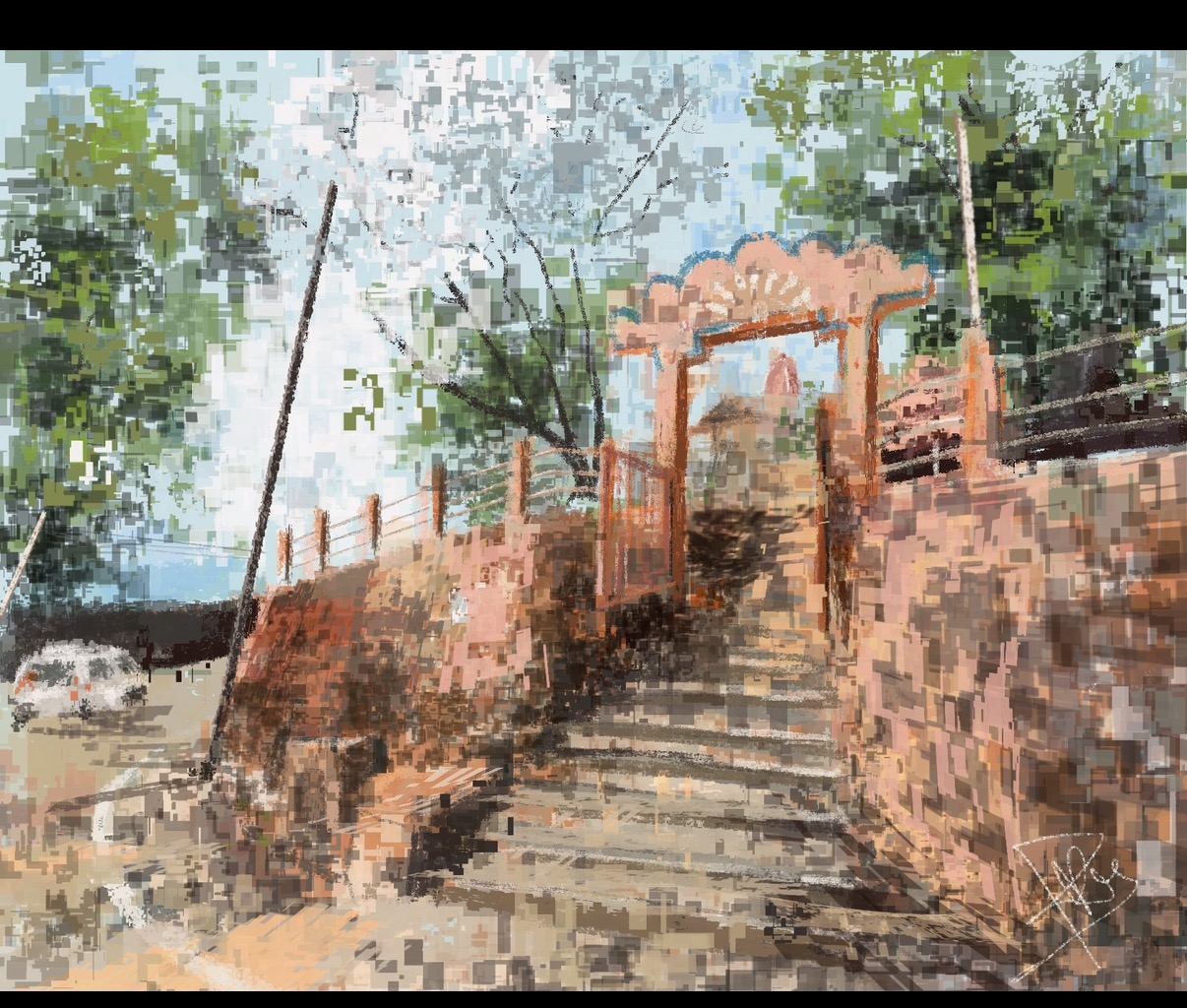
A reference image does not have to become an exact copy. For this illustration of Navagraha Temple in Guwahati, Assam, I used a photographic reference to understand the architecture, perspective and overall composition, then rebuilt the scene manually in Procreate in my own visual style.
I drew the linework myself rather than tracing the reference. I also chose the colours independently instead of sampling them directly from the photograph. From the beginning, I wanted the finished piece to have a deliberately pixelated character rather than the smooth finish of a realistic digital painting. The complete artwork took me roughly three to four hours.
1. Reading the reference before drawing
Before adding colour, I first needed to understand what made the scene recognizable. The entrance, staircase, gateway, surrounding walls and trees create the basic structure of the view. A photograph contains many small details, but trying to reproduce every one of them would work against the simplified style I wanted.
I therefore treated the reference as visual information rather than something that had to be copied literally. The larger shapes and perspective were more important to me than reproducing every texture, branch or surface exactly as it appeared.
2. Drawing the linework myself
I created the linework manually while looking at the reference. This was an important stage because it allowed me to interpret the architecture rather than simply trace over it. I could decide which edges needed to be clear, which shapes could be simplified and which smaller details could be left out.
Working this way also made the drawing feel more like my own interpretation of the place. The reference established the subject and perspective, but the construction of the illustration happened through my own observation and drawing.
3. Choosing a pixelated visual style
I did not aim for photorealism. Instead, I deliberately worked toward a pixelated art form. That meant thinking about the scene in blocks, edges and simplified areas rather than trying to blend everything into smooth photographic surfaces.
The pixelated approach also suited the process of deciding what information was essential. Trees did not need every leaf, stone surfaces did not need every irregularity, and architectural forms could be reduced while remaining recognizable. Simplification became part of the character of the finished illustration rather than a limitation.
4. Building my own colour palette
I chose the colours myself instead of picking them directly from the photographic reference. The photograph helped me understand the relationships between the different parts of the scene, but I wanted control over how those relationships appeared in the artwork.
This gave me room to interpret the atmosphere rather than reproduce the exact colour values recorded by the camera. For me, that is one of the differences between using a photograph as a reference and trying to create a digital copy of it: the reference provides information, while the artwork still requires decisions.
5. Refining the scene
Once the main drawing and colours were established, the remaining work was about balancing detail with the pixelated style. I could add enough information to make the temple entrance, steps and surrounding environment readable without losing the simplified quality I wanted.
I do not remember the exact Procreate brushes I used for this piece, so I would rather not turn the process into a brush recipe. The more important part of the workflow was observation: constructing the linework, simplifying the reference, choosing the colours and maintaining a consistent visual language across the illustration.
The finished Navagraha Temple illustration
The final image took approximately three to four hours to complete. What began as a photographic reference became a manually drawn interpretation of Navagraha Temple through line, colour and a pixelated digital style.
For me, this is what makes working from references interesting. The photograph tells me what was in front of the camera. Drawing gives me the opportunity to decide what deserves to remain, what can disappear and how the scene can become something visually different.
Watch the complete Procreate process
You can also watch the illustration develop from the early stages to the finished artwork in my Navagraha Temple timelapse.